
Business Strategy: Part 1 - Revitalise your business before it's too late...
About the Author:
Paul Wilton (editor)
CA with degrees in commerce, accounting and information technology. Paul worked overseas in the “Big 4” accounting firms and served as a director at Audit New Zealand before setting up his own consultancy. Author of A-Z of New Zealand Business Law, Paul has over 20 years of experience as a business owner and consultant. He joined FBA in 2004 and is totally committed to providing excellence in quality and value to our subscribers.
This is the first of a three part series on Business Strategy. Click here for part 2, click here for part 3
What better time to update your business direction and set a fresh path than now? You have pulled through the worst times while some competitors may have fallen by the wayside and you are poised to benefit from better times ahead.
Things change. No one would suggest that the business environment today is the same as it was just a few years ago. Each business is affected differently by changes in the economy, their own industry, technology, competition and so on…
You may see the changes as good or bad for your business. But what is certain, is that change happens and you need to respond positively, in a way that puts your business in the best position possible to benefit from new opportunities and stay ahead of the game.
This is the first of a three-part series on setting your strategic direction. In this issue, we set the scene but also provides practical advice to give you a head start, enabling you to get on with the job of revitalising your business.
How far to go?
Your business strategy provides your high-level focus and direction. It sets the priorities that determine what you do and the key parameters that help with decisions on how to do it. The strategy provides the framework on which your business plan is built. Whether you have documented your strategy or not (and we believe you should), you will have a reasonably clear picture of what you do, who your customers are and why they do business with you.
Revitalizing your strategy entails challenging the things that you have been taking for granted and asking yourself whether you are doing the right things and whether you are doing them in the right way.
Consider the following matrix:
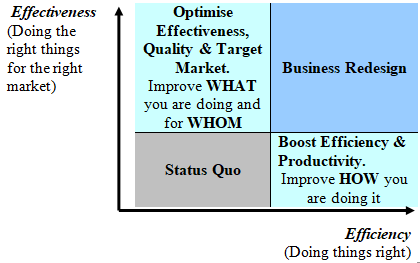
Your strategy is only valuable if it is being used as a guide to drive your direction and decision-making. It is a living and active tool and must be reviewed and updated as required. From the above matrix, it is clear that you can implement new strategies to enhance your efficiency and effectiveness. How far you go will depend on your current circumstances, stage of business development and external change triggers.
When is it too late?
Let’s look at the extreme case of a total business redesign. This is where you re-evaluate your target market and the way you are meeting their needs with an open mind - being prepared if necessary to overhaul your business completely, changing your main focus, values and direction. Why would you ever want to do this and when would it make sense to do so?
The following graph shows the typical growth cycle of a successful business, recording financial performance:
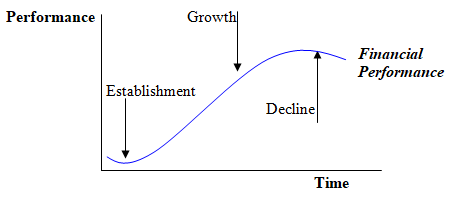
Known as the “S curve” due to its shape, the graph shows how a business will normally be slow to get off the ground. If it is a winner, it will take off and do well before tapering off due to changes in the business environment. The best businesses anticipate the need to change before it is glaringly obvious from the results. In the extreme cases, they redesign and are able to jump to a new financial performance S curve extending growth before it is too late as follows:
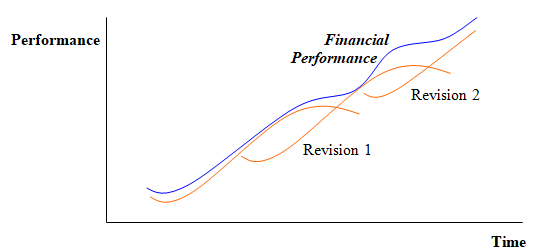
The current edition of the Harvard Business Review is running a feature article by Paul Nunes and Tim Breene of global consulting company, Accenture, summarising the findings of their research into organisational performance. They examined over 800 companies over many years and found some interesting correlations between business reinvention and success. They observed that the high performers in their study had started the reinvention process well before their financial results had indicated that this was necessary.
“To survive over the long haul, a company must reinvent itself periodically, jumping from the flattening end of one business performance curve to the rising slope of another. Very few companies make the leap successfully when the time comes. That’s because they start the reinvention process too late.”
Paul Nunes and Tim Breene (Harvard Business Review Jan-Feb 2011)
The study revealed three leading indicators that show the best time for a radical business design. Nunes and Breene summarised their findings in the following graph:
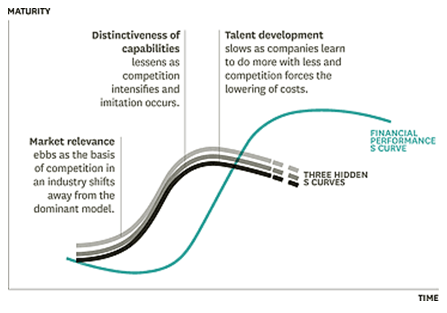
They observed that before reaching the point of decline, this is what happened to companies in their study:
They began to lose their competitive edge in terms of their distinct capabilities;
There was an increase in their competition so they became less relevant in the market in which they operated; and
The senior decision-makers in the company were running out of fresh ideas to deal with the issues.
This makes sense, but only the high performing companies in the study actually tracked these indicators, recognised the right time to revitalise the business and actually did something about it. These are the companies that went from strength to strength, even during the period of the recession.
The best performing businesses changed what they were doing, redefined their primary customers and injected new talent into their business in time to avoid reaching the point of decline. This is possible even for the smallest of businesses. Refer to our article on The Power of 3 (Page …) where we show how to inject new talent and ideas into your business in an effective and affordable way without taking on new staff or hiring consultants.
How to Reinvent Your Business
Steve Strauss from USA today (www.usatoday.com) suggests asking the following questions to help you reinvent your business:
1.What if I was just starting out? Pretend you are just starting in business again. What sorts of ideas might you try?
2.What would be fun and exciting? Successful business reinvention usually occurs when the entrepreneur taps a new idea that gets the creative juices flowing.
3.Where is the opportunity? You know your industry as well as anyone. Where is it being underserved? Can you fill that gap? Gap fillers are money makers.
4.What can I offer that is different? You don't have to be an innovator to be a successful re-inventor but it doesn't hurt.
Refer to our article on 7 Essential Strategy Questions to Ask Yourself for some more in-depth ideas on setting a new strategic direction.
Conclusion
Whether your business is due for a total overhaul or just for some revitalisation to improve your efficiency and effectiveness in existing markets, now is a good time to review your strategy. The businesses that will do best as the economy pulls out of the doldrums are the ones that do not leave this until it is too late. Over the next couple of issues we’ll be providing more advice on keeping your strategy fresh, relevant and up to date.
Sources:
Related Articles

Reignite the Passion